
logo
À propos de nous

Shenzhen Rona Intelligent Technology Co., Ltd

voir plus
demandez un devis
Je ne sais pas.
Je ne sais pas.
Je ne sais pas.
Pourquoi?
Choisissez nous
picurl
Haute qualité
Le sceau de confiance, la vérification du crédit, le RoSH et l'évaluation de la capacité des fournisseurs. La société dispose d'un système de contrôle de qualité strict et d'un laboratoire de test professionnel.
picurl
DÉVELOPPEMENT
Équipe de conception professionnelle interne et atelier de machines avancé. Nous pouvons coopérer pour développer les produits dont vous avez besoin.
picurl
Produits manufacturés
Des machines automatiques avancées, un système de contrôle strict du processus. Nous pouvons fabriquer tous les terminaux électriques au-delà de votre demande.
picurl
100% de service
En vrac et en petits emballages sur mesure, FOB, CIF, DDU et DDP. Laissez-nous vous aider à trouver la meilleure solution pour toutes vos préoccupations.
SOLUTION
SOLUTION
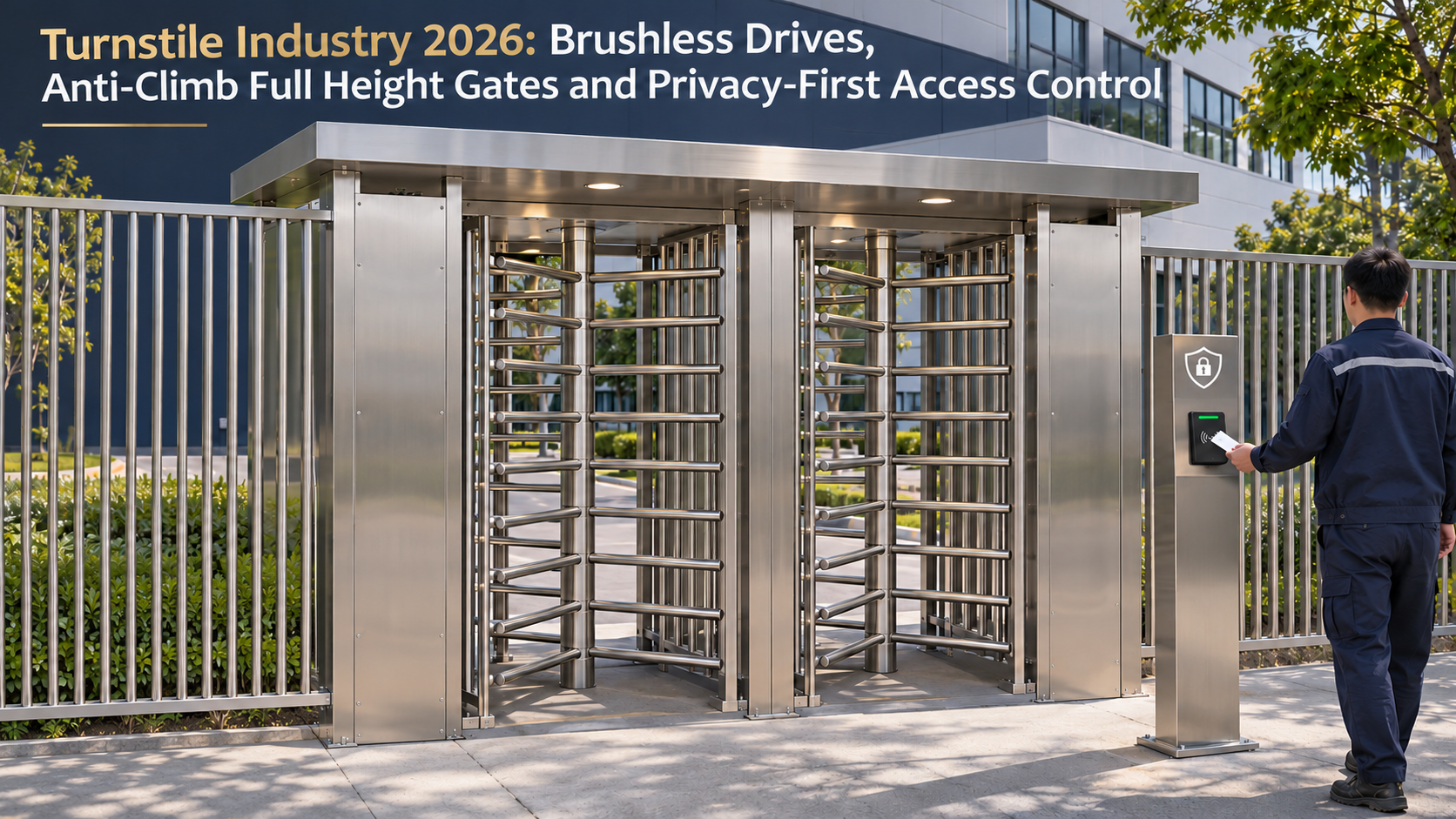
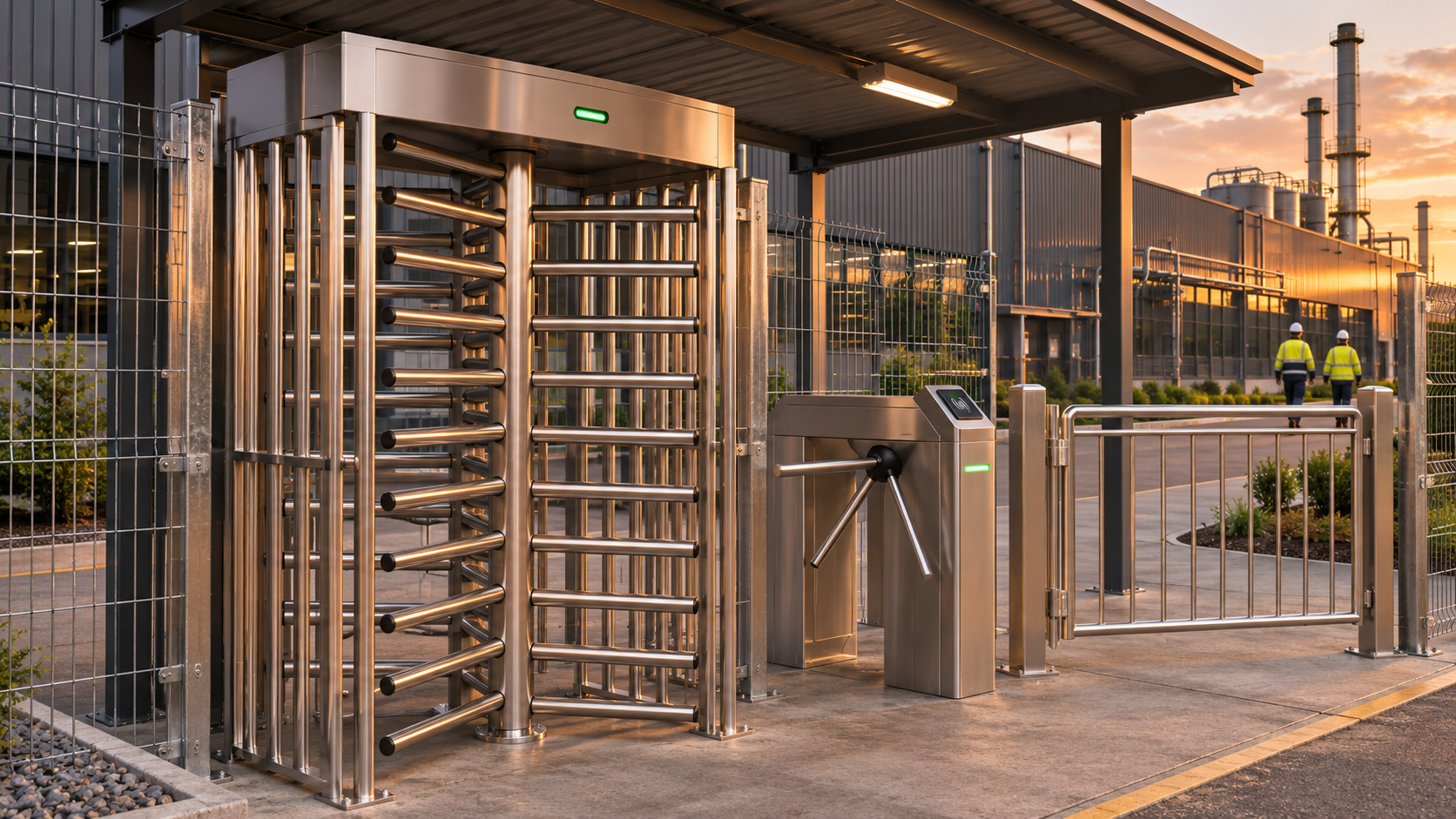
  • North China Factory Installs Semi-Automatic Full Height Turnstiles with Anti-Climb Anti-Tailgating Design
    11-16 2026
    A manufacturing plant in northern China needed to lock down its perimeter pedestrian access against intrusion, climbing and tailgating — without posting a guard at every gate. The plant installed semi-automatic full height turnstiles at its main staff entrance and its restricted workshop corridor. Years into service the units run continuously with no recorded failure. Customer Background Location: Northern China — cold winters, dust, wide seasonal temperature swing Sector: Manufacturing / industrial plant Access points: Main staff entrance and a restricted workshop corridor Security requirement: Anti-climb, high-security pedestrian control, strict anti-tailgating Operating pattern: Two shift changes per day, plus contractor and visitor traffic The Security Problem The plant sits on an open industrial estate where perimeter fencing alone was not enough. Three risks drove the specification: Climbing and vaulting. Waist-high flap or tripod barriers can be stepped over in seconds; the plant needed a barrier tall enough that climbing is impractical. Tailgating and piggybacking. Two people passing on one authorised card was routine at shift change — and unacceptable to an auditor. Reverse rotation. Once inside the rotor, arms could be pushed backwards to let a second person slip through. Delivered Solution and Technical Specification Parameter Specification Security Benefit Product type Semi-automatic full height turnstile Full-height cage enclosure blocks climbing and vaulting Dimensions L2400 × W1350 × H2200 mm 2200 mm overall height leaves no handhold or foothold for an intruder Rotor configuration 120° rotor, three-arm One person per 120° rotation — the chamber admits a single body at a time Anti-reverse function 60° anti-reverse lock Arms cannot be pushed backwards mid-transit; removes the piggyback route Tailgating control Single-entry chamber logic Each authorised card yields exactly one rotation, one person Mechanism Yellow galvanised movement assembly Zinc coating resists corrosion and abrasion in dust-heavy conditions Operation mode Semi-automatic (manual push, damped return) No motor wear from constant cycling; safe for high-volume shift traffic Service record 5–8 years, no failure reported Verified by customer after multi-year field operation Why Semi-Automatic Full Height Was the Right Choice Motorised full height units are fast, but the motor is the part most exposed to wear at two heavy shift changes a day, and a dead gate at shift handover is an operational crisis. A semi-automatic unit removes the risk: the user pushes the rotor through and a damped mechanism returns it home. No drive motor cycling hundreds of times daily, no controller to fail, and no power failure that can trap someone in the chamber. How the Anti-Climb and Anti-Tailgating Design Works Anti-climb. At 2200 mm high with enclosed side panels and a 1350 mm wide cage, the structure presents no grip point. The rotor arms sit well above waist height, so nobody can lever over the top or squeeze between arms and frame. 120° rotor, one person per rotation. The three-arm rotor divides the chamber into three 120° sectors. Pushing through advances exactly one sector — the geometry itself enforces single-person entry, independent of software. 60° anti-reverse lock. Once the rotor moves 60° past home, a mechanical lock engages and the arms cannot be driven backwards. A tailgater following a cardholder has no route through; the second person is physically excluded. Durability in a Northern China Climate Sub-zero winters, wind-blown grit and heavy summer dust are hard on outdoor hardware. The galvanised yellow mechanism was chosen for exactly that: the zinc layer sacrifices itself before the base steel, so rotor bearing surfaces and locking pawls stay free of rust and abrasion. With a semi-automatic architecture the number of wearing components is small — hence 5–8 years of failure-free duty on the original mechanism. Results and Client Feedback At the main entrance the new full height turnstiles restored a one-card-one-person rule at peak shift change without adding guard headcount. The workshop corridor is now genuinely restricted: no climbing route exists, and the 60° anti-reverse lock closed the piggyback gap the audit team had flagged. The maintenance log shows no failures across 5–8 years of service. Conclusion This northern China factory project shows why the full height turnstile remains the reference solution wherever genuine anti-climb and anti-tailgating performance is required. A 2200 mm enclosure, a 120° single-person rotor, a 60° anti-reverse lock and a wear-resistant galvanised mechanism work together as a mechanical guarantee, and semi-automatic operation takes the motor out of the reliability equation entirely.
  • Guangdong University Deploys Brushless Flap Barrier Turnstiles for High-Throughput Campus Access Control
    11-16 2026
    In a public university in Guangdong Province, China, the campus management team replaced the ageing entry gates at three high-traffic pedestrian points — the main library entrance, the teaching-building lobby and the dormitory zone — with a bank of brushless flap barrier turnstiles. The campus accommodates more than 20,000 students and staff, and the previous gates simply could not absorb the 7:40–8:20 morning peak. After a competitive tender, the university selected a brushless, economically priced flap barrier configuration that delivered measurable throughput gains without exceeding the capital budget. Customer Background Location: Guangdong Province, China (humid subtropical climate, high pedestrian volume) Sector: Higher education — public university campus Population served: 20,000+ students, faculty and campus staff Access points upgraded: Library entrance, teaching-building lobby, dormitory zone Access credential: Campus smart card / QR code / face recognition integration Challenges the University Faced Queue build-up at peak hours. Legacy swing gates allowed roughly 15–18 persons per minute; queues backed up 40–60 metres into the campus plaza every morning. High maintenance cost. Brushed motors required frequent brush replacement in the humid Guangdong climate, generating recurring labour and downtime. Safety concerns. Students walking with umbrellas, laptops and backpacks frequently struck the moving wings; the old units had no effective rebound protection. Budget discipline. As a public institution, the university required an economical solution with a low total cost of ownership across a five-year service life. Tight installation window. The works had to be completed during the eight-week summer break. Delivered Solution and Technical Specification The selected model is a single-lane brushless flap barrier turnstile with transparent acrylic wings, supplied in the compact footprint shown below. Parameter Specification Project Benefit Dimensions L1500 × W280 × H990 mm Compact 280 mm cabinet width preserves corridor space while the 1500 mm length houses a full-length wing travel Drive system Brushless DC motor No carbon brush wear, maintenance-free operation, lower noise and far longer service life Control board Brushless motor controller board Accurate position feedback, smooth acceleration ramp, self-diagnostics on start-up Barrier wings Transparent acrylic Full visibility for security staff, modern appearance, impact-resistant and easy to clean Throughput 25–30 persons per minute Roughly 60% higher peak flow than the replaced gates Collision protection Mechanical anti-collision + force-resistance anti-collision (dual protection) Wings absorb and rebound on impact; motor torque limits before injury or damage occurs Positioning Economical high-volume configuration Best cost-per-lane ratio in the tender evaluation Performance Data After Handover Metric Before Upgrade After Upgrade Verified throughput per lane 15–18 persons/min 25–30 persons/min Morning-peak queue length 40–60 m Under 10 m Motor brush maintenance Every 6 months None required (brushless) Wing-impact incidents reported Recurring weekly Zero injury reports in first semester Installation duration — Completed within the 8-week summer break How the Dual Anti-Collision Design Works in Practice Two independent layers protect students at the gate line: Mechanical anti-collision. The acrylic wing is mounted on a sprung clutch. When a student brushes or strikes the wing, the wing physically gives way instead of stopping dead, then returns to its home position automatically. No motor stall, no broken wing. Force-resistance anti-collision. The brushless controller continuously monitors motor current. If resistance exceeds the configured threshold — for example a person leaning on the wing — the drive instantly reverses and releases, limiting the applied force well below the level that could cause injury. For a campus where students walk shoulder-to-shoulder with umbrellas, trolley bags and bicycles at the same time, this combination proved to be the decisive factor in the tender scoring. Why the Brushless Configuration Was Chosen Guangdong's humid, salt-laden air is notoriously hard on brushed motors: carbon brushes wear quickly and commutators corrode. By moving to a brushless motor and brushless control board, the university removed the single largest recurring maintenance item from its five-year budget. In parallel, the brushless drive runs quieter — an important point for the library entrance — and delivers more consistent torque across the full wing cycle, which is exactly what sustained 25–30 persons per minute demands. Results and Client Feedback Across the first full semester of operation, the three upgraded access points handled the morning peak without a single queue extending beyond the entrance plaza. Campus security reported zero wing-impact injuries, and the facilities team confirmed no motor maintenance was required. The university's project lead summarised the outcome simply: the gates are economical, durable and fast — precisely the three priorities set at the start of the tender. Conclusion This Guangdong university project demonstrates that a well-specified, economically positioned brushless flap barrier turnstile can deliver enterprise-grade reliability on a public-institution budget. Compact dimensions, transparent acrylic wings, verified throughput of 25–30 persons per minute and layered mechanical plus force-resistance anti-collision protection together form a repeatable blueprint for campus, factory and office-park access control projects worldwide.
  • Cas de barrière d'oscillation du hall du bureau: portes sans pinceau avec 8 paires IR et accès Face + QR
    09-16 2026
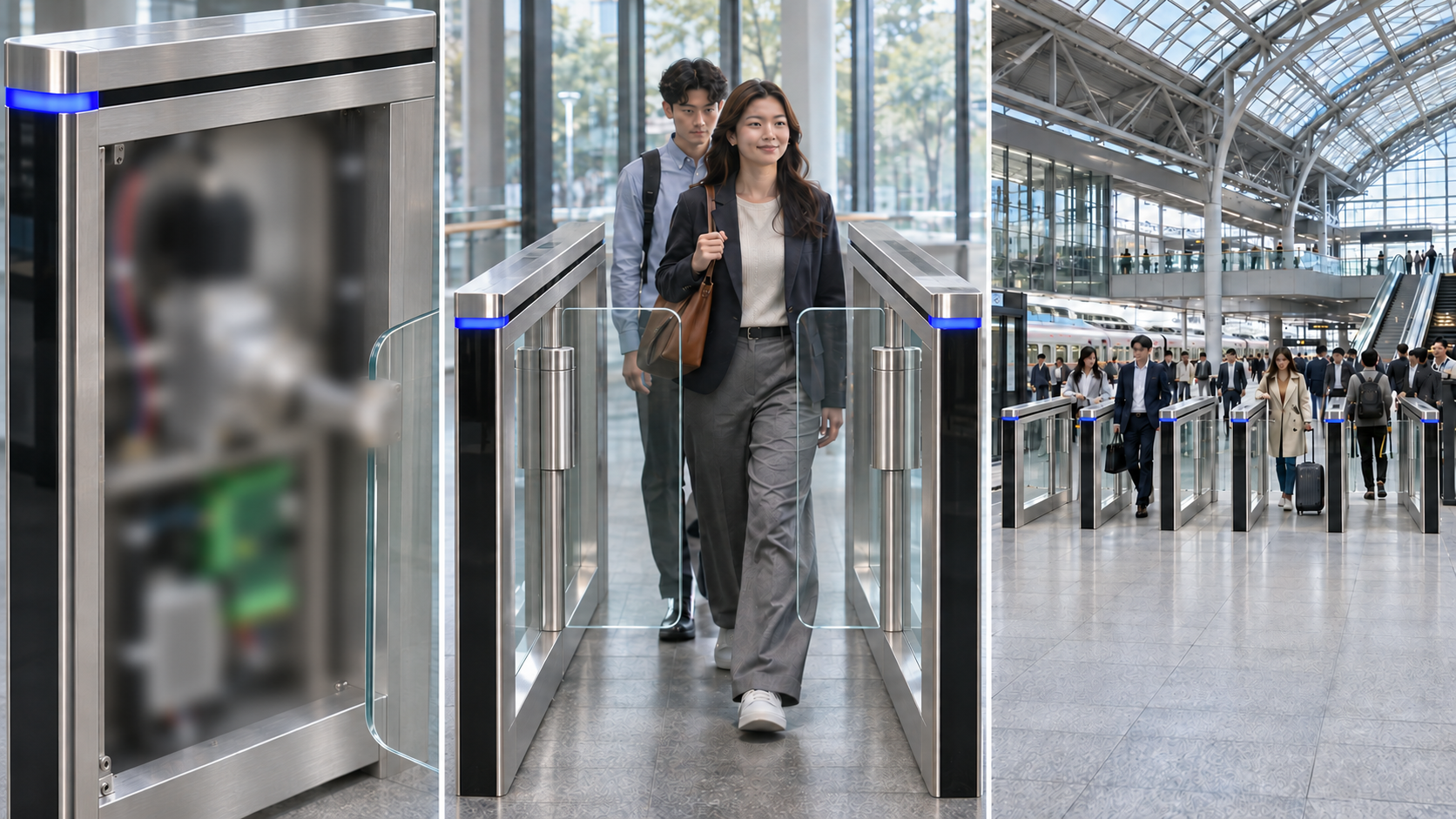
    Le hall d'un immeuble de bureaux est l'une des entrées les plus visibles et les plus dynamiques de toute propriété commerciale. Il doit gérer un flux quotidien élevé d'employés et de visiteurs, avoir une apparence suffisamment élégante pour correspondre à la marque du bâtiment et empêcher les entrées non autorisées, le tout en même temps. Cette étude de cas présente un projet de contrôle d'accès de hall basé sur des portillons battants sans balais avec détection infrarouge à 8 paires et accès combiné reconnaissance faciale + code QR. Contexte du projet Le site était le hall principal d'un immeuble de bureaux moderne. La direction avait besoin d'une solution de contrôle de passage qui s'intégrerait à un intérieur propre et contemporain tout en gérant le trafic aux heures de pointe. Les exigences clés étaient claires : Une apparence élégante et minimaliste pour correspondre au design du hall Un passage rapide et fiable pour les employés pendant les heures de pointe Deux méthodes d'accès : reconnaissance faciale et code QR Détection anti-queue précise pour empêcher les entrées non autorisées Faible bruit et longue durée de vie pour un fonctionnement quotidien continu La solution : Portillons battants sans balais La configuration choisie était un ensemble de portillons battants sans balais installés à l'entrée du hall. Les portillons battants offrent un passage large et naturel qui convient aux environnements de bureau, tandis que le moteur sans balais apporte de réels avantages dans un hall qui fonctionne toute la journée : fonctionnement plus doux et plus silencieux, moins d'usure mécanique, une efficacité énergétique accrue et une maintenance réduite sur la durée de vie du produit. Le boîtier fin et profilé du portillon, ainsi que sa finition épurée, offrent exactement le look simple et élégant que le client exigeait. Détection infrarouge à 8 paires Chaque voie était équipée de 8 paires de capteurs infrarouges. Un réseau infrarouge dense améliore considérablement la précision de la détection : il distingue une personne d'un sac ou d'un chariot, suit la direction du mouvement et empêche le dépassement (tailgating) – une fonction de sécurité essentielle dans un hall de bureau où le personnel et les visiteurs passent côte à côte. Cette détection dense rend également le passage plus rapide et plus sûr, car les portes ne se fermeront pas sur un utilisateur légitime en cours de passage. Accès par reconnaissance faciale + code QR La couche d'accès combinait des terminaux de reconnaissance faciale avec des lecteurs de codes QR, offrant au bâtiment deux méthodes d'entrée complémentaires. Les employés peuvent entrer sans les mains grâce à la vérification faciale, tandis que les visiteurs, les sous-traitants et le personnel temporaire utilisent des codes QR émis par le système de gestion des visiteurs. La combinaison rend l'expérience pratique pour les utilisateurs réguliers et contrôlée pour les invités, sans ajouter de portillon séparé ni de point de contrôle manuel. Résumé de la configuration du produit Article Spécification Type de produit Portillon battant sans balais Application Hall principal d'un immeuble de bureaux Détection infrarouge 8 paires par voie Méthodes d'accès Reconnaissance faciale + code QR Finition Design simple et élégant Fonctions clés Anti-dépassement, anti-collision, fonctionnement silencieux Résultats et avantages Débit fluide aux heures de pointe avec accès facial mains libres Gestion flexible des visiteurs via codes QR Anti-dépassement fiable grâce à la détection infrarouge à 8 paires Moteurs sans balais silencieux et nécessitant peu d'entretien, adaptés au fonctionnement toute la journée Une entrée propre et moderne qui complète l'image de marque du bâtiment Conclusion Pour les halls d'immeubles de bureaux, la bonne solution de contrôle de passage équilibre l'apparence, la vitesse, la sécurité et la fiabilité. En combinant des portillons battants sans balais, une détection infrarouge à 8 paires et un accès par reconnaissance faciale + code QR, ce projet offre une entrée élégante, facile à utiliser et sécurisée par conception – une référence pratique pour des projets de halls commerciaux similaires.
Les derniers blogs
Découvrez les derniers blogs
Nous contacter
Enquête
Si vous avez des questions, veuillez nous contacter immédiatement et nous vous répondrons dès que possible.
Vous pouvez aussi nous suivre sur les réseaux sociaux.
008613554907786